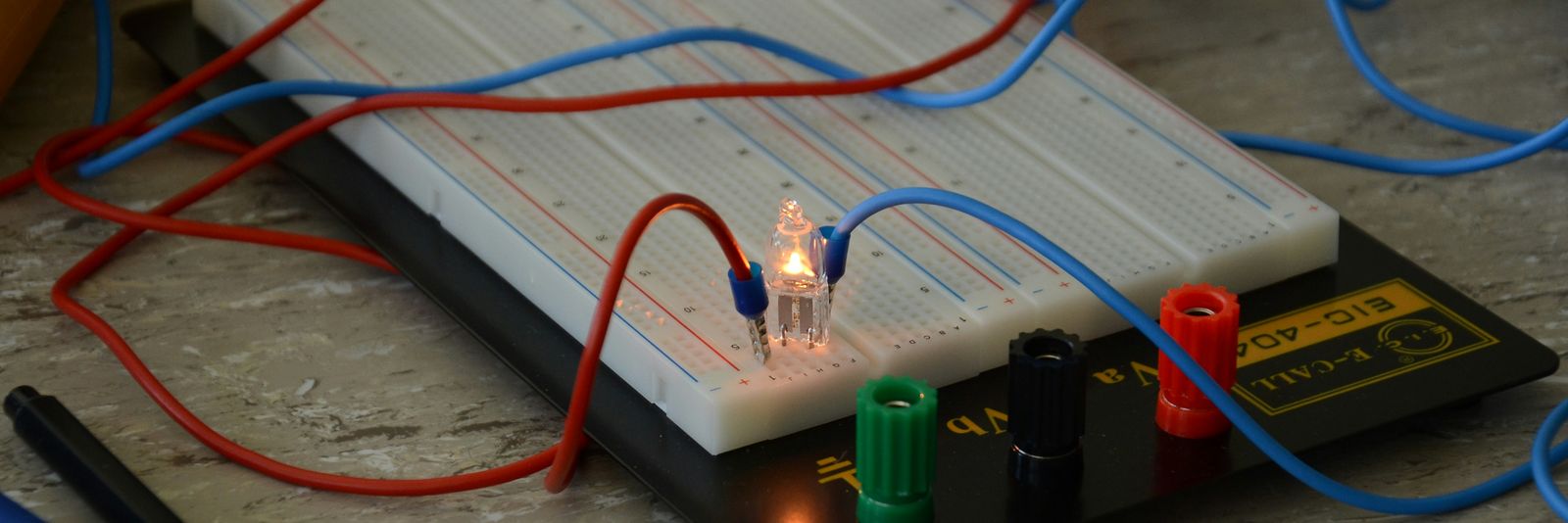
An electric current is the flow of electric charge through a material. In the wires of a classroom circuit the moving charges are electrons, which drift through the metal when a battery pushes on them. No push, no current. A broken path, no current either.
What a complete circuit needs
Three things have to be present before anything lights up.
- A source of energy. A battery or cell, which supplies the push, called voltage.
- A conducting path. An unbroken loop from one end of the battery, through the device, and back to the other end.
- A load. Something that uses the energy, such as a bulb, a buzzer, or a motor.
The loop matters more than students expect. A bulb wired to only one end of a battery will not light no matter how fresh the battery is, because charge has nowhere to return to. A switch works by deliberately breaking the loop, and closing it again.
Conductors and insulators
A conductor lets charge move through it easily. Metals are the common ones: copper, aluminium, steel. A wire is copper for this reason. An insulator resists that movement. Rubber, dry wood, glass, most plastics, and dry air are insulators, which is why wires are wrapped in plastic and why a plug has a plastic body.
| Material | Behaviour | Everyday use of that behaviour |
|---|---|---|
| Copper | Conductor | The wire inside a cable |
| Steel paper clip | Conductor | Closes a test circuit |
| Rubber | Insulator | The coating around a wire |
| Glass | Insulator | Supports on power lines |
| Pencil lead, which is graphite | Conductor, but a poor one | Shows that conducting is not all or nothing |
Series circuits
In a series circuit there is exactly one path. The current passes through every component in turn. Two consequences follow, and both are easy to test on a desk.
- Adding a second bulb makes both bulbs dimmer, because the same push is now spread across more of the circuit.
- Unscrewing one bulb stops the other one too, because the single path is broken.
Parallel circuits
In a parallel circuit the current has more than one path. Each bulb sits on its own branch between the same two points of the circuit.
- Each bulb stays at full brightness when another is added, because each branch gets the full push of the battery.
- Removing one bulb leaves the others lit, because their branches are untouched.
House wiring is parallel. If it were series, switching off one lamp would darken every room, and every appliance would dim as others were switched on.
Safety
Classroom circuits use single cells for a reason. Mains electricity carries enough push to drive a dangerous current through a person, who is a fairly good conductor because of the water and salts in the body. Water on the skin makes it worse. The rule that follows is not a slogan: never experiment with wall sockets, and keep circuits dry.
Check yourself
A bulb is connected by one wire to one end of a battery. Will it light?
No. There is no return path, so the loop is not complete and no current flows. A second wire from the other side of the bulb to the other end of the battery is needed.
Two bulbs in series, one is unscrewed. What happens to the other?
It goes out. A series circuit has a single path, and unscrewing a bulb breaks it for everything on that path.
Why is the wire copper but the coating rubber?
Copper is a good conductor, so charge moves through it easily. Rubber is an insulator, so it keeps the current inside the wire and away from hands and other wires.
Why is a house wired in parallel rather than in series?
So that each light and appliance works independently at full brightness. In series, switching off or removing any one of them would cut the current to all of them, and adding more would dim everything.
See also
Sources
- This page covers the elementary circuits strand common to United States state science standards for grades 3 to 5. Diagrams are drawn for this site.