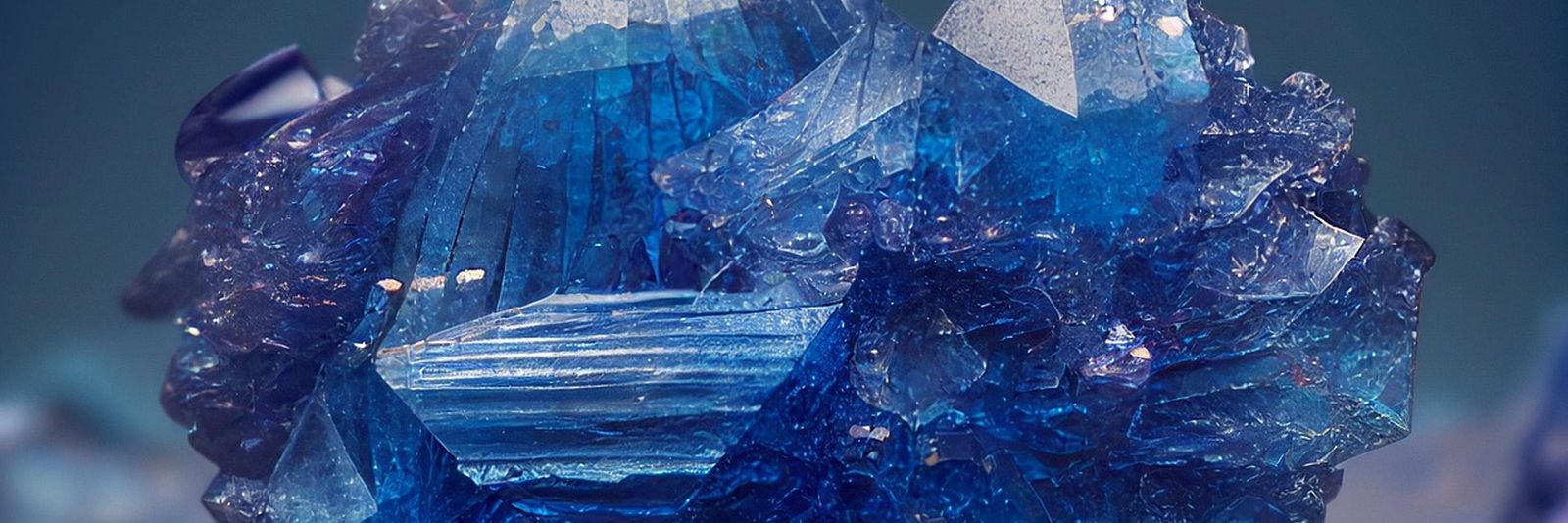
A mineral is a naturally occurring solid with a definite chemical composition and an orderly crystal structure. A rock is a solid made of one or more minerals. Quartz is a mineral. Granite is a rock, made mostly of quartz, feldspar and mica.
Identifying a mineral
| Property | What it means |
|---|---|
| Hardness | resistance to scratching, compared on the Mohs scale from talc at 1 to diamond at 10 |
| Streak | the colour of the powder left when rubbed on a tile, often different from the mineral's own colour |
| Luster | how the surface reflects light, described as metallic or non metallic |
| Cleavage | whether it breaks along flat planes or into irregular pieces |
| Colour | the least reliable property, since impurities change it |
The three rock types
- Igneous. Formed when molten rock cools and hardens. Cooling slowly underground grows large crystals, as in granite. Cooling quickly at the surface leaves crystals too small to see, as in basalt.
- Sedimentary. Formed when sediments settle in layers and are pressed and cemented together over long periods. Sandstone, shale and limestone are examples, and fossils are found almost exclusively in this type.
- Metamorphic. Formed when existing rock is changed by heat and pressure without melting. Limestone becomes marble, and shale becomes slate.
The rock cycle
How rock moves between the three types
melting and cooling -> igneousweathering, erosion,burial and cementing -> sedimentaryheat and pressure -> metamorphic any type can become any other typethere is no fixed starting point
The cycle has no beginning and no required order. Metamorphic rock can be weathered into sediment, and sedimentary rock can be melted. That is the point students most often miss when the cycle is drawn as a simple loop.
Soil
Soil is a mixture of weathered rock particles, decayed organic material called humus, water and air. Humus supplies nutrients and helps soil hold water, which is why topsoil, the upper layer richest in humus, is the layer that supports plant growth. It forms very slowly, taking centuries to build a few centimetres, and can be lost to erosion in a single season.
| Type | Particles | Behaviour |
|---|---|---|
| Sand | largest | drains fast, holds few nutrients |
| Silt | medium | holds water and nutrients reasonably well |
| Clay | smallest | holds water tightly, drains poorly, packs hard |
| Loam | a mixture of all three | the balance most plants grow best in |
Common mistakes
Identifying a mineral by colour
Quartz can be clear, pink, purple or white. Hardness and streak are far more dependable.
Thinking the rock cycle runs in one order
Any rock type can become any other. The arrows go both ways.
Check yourself
Is granite a mineral or a rock?
A rock. It is a mixture of several minerals, mainly quartz, feldspar and mica.
Where are fossils usually found, and why?
In sedimentary rock. It forms from layers of sediment settling gently, which can bury remains without destroying them, while igneous and metamorphic rock involve heat that would destroy them.
Limestone is buried and subjected to heat and pressure. What does it become?
Marble, a metamorphic rock.
Why does sandy soil dry out quickly?
Its particles are large, so the spaces between them are wide and water drains straight through.
See also
Sources
- Minerals, rock types, the rock cycle and soil composition as taught in United States upper elementary earth science. Examples on this page are our own.