Two different movements explain most of what we see in the sky. The earth rotates on its axis once a day, and it revolves around the sun once a year. Keeping the two apart is the key to the whole topic.
Day and night
The earth turns on its axis once every 24 hours. The half facing the sun has day, the half facing away has night, and the line between them sweeps around the planet as it turns. The sun does not move across the sky. We turn.
Seasons
Seasons are caused by the tilt of the earth's axis, about 23.5 degrees, which stays pointed the same way in space all year. When the northern hemisphere is tilted toward the sun, its sunlight arrives more directly and for more hours a day, giving summer. Six months later the same hemisphere is tilted away and has winter, while the southern hemisphere has summer.
The distance explanation is wrong. Students often say summer happens when the earth is closer to the sun. If that were the cause, the whole planet would have summer at once, and it does not. When it is July in Argentina it is winter there.
Phases of the moon
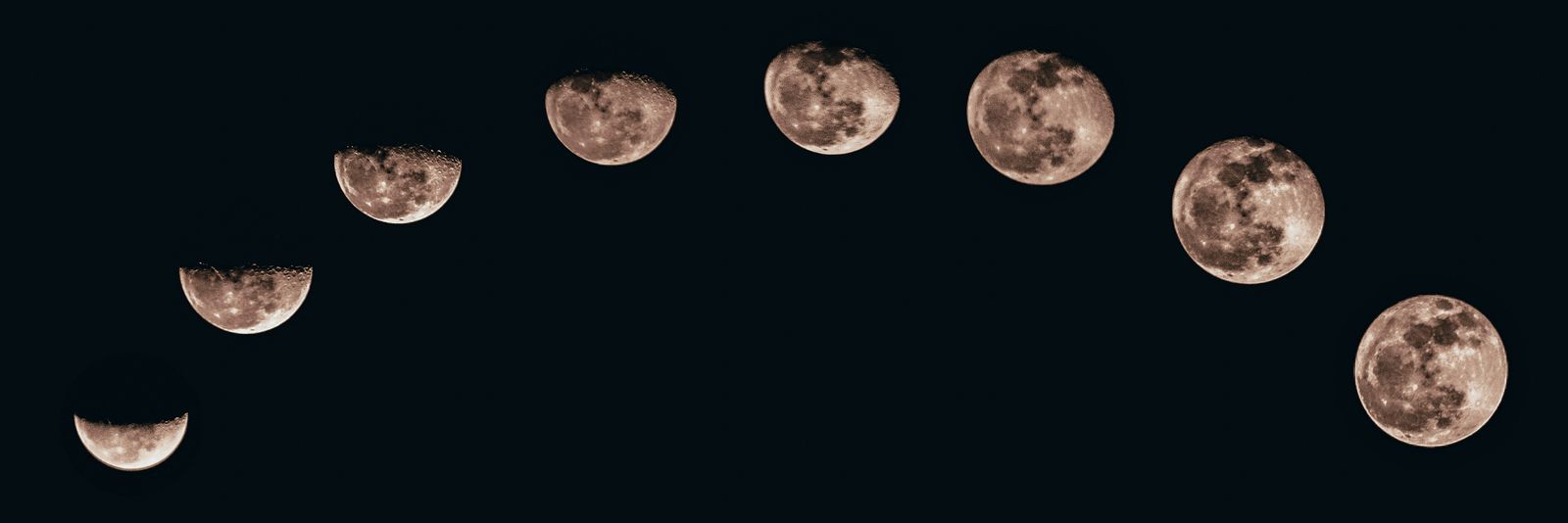
The moon does not make light. It reflects sunlight, and half of it is always lit. The phase we see depends on how much of that lit half faces us as the moon travels around the earth, which takes about 29.5 days.
| Phase | What you see |
|---|---|
| New moon | the lit side faces away, so the moon is not visible |
| Waxing crescent | a thin sliver, growing |
| First quarter | half the disc lit, growing |
| Waxing gibbous | more than half, growing |
| Full moon | the whole lit side faces us |
| Waning gibbous, last quarter, waning crescent | the same shapes in reverse, shrinking |
Waxing means growing and waning means shrinking. The earth's shadow has nothing to do with the phases, which is the second most common error in this topic.
Eclipses
- Solar eclipse. The moon passes between the sun and the earth, and the moon's shadow falls on part of the earth. This can only happen at new moon.
- Lunar eclipse. The earth passes between the sun and the moon, and the earth's shadow falls on the moon. This can only happen at full moon.
Eclipses do not happen every month, because the moon's orbit is tilted slightly relative to the earth's orbit, so the three bodies usually fail to line up exactly.
The planets
In order from the sun: Mercury, Venus, Earth, Mars, Jupiter, Saturn, Uranus, Neptune. The first four are small and rocky. The next four are much larger and made mostly of gas and ice. Pluto was reclassified as a dwarf planet in 2006.
Common mistakes
Swapping rotation and revolution
Rotation is spinning on the axis and gives day and night. Revolution is the orbit around the sun and gives the year.
Explaining phases with the earth's shadow
That describes a lunar eclipse, which is rare. Phases come from which part of the lit half is turned toward us.
Check yourself
What causes day and night?
The earth rotating on its axis once every 24 hours.
Why is it winter in Australia during July?
Because the southern hemisphere is tilted away from the sun then, so sunlight arrives at a lower angle and for fewer hours.
At which phase can a solar eclipse happen?
New moon, since only then is the moon between the earth and the sun.
Which planets are the rocky ones?
Mercury, Venus, Earth and Mars, the four closest to the sun.
See also
Sources
- Earth, moon and sun relationships as taught in United States upper elementary earth science. Examples on this page are our own.