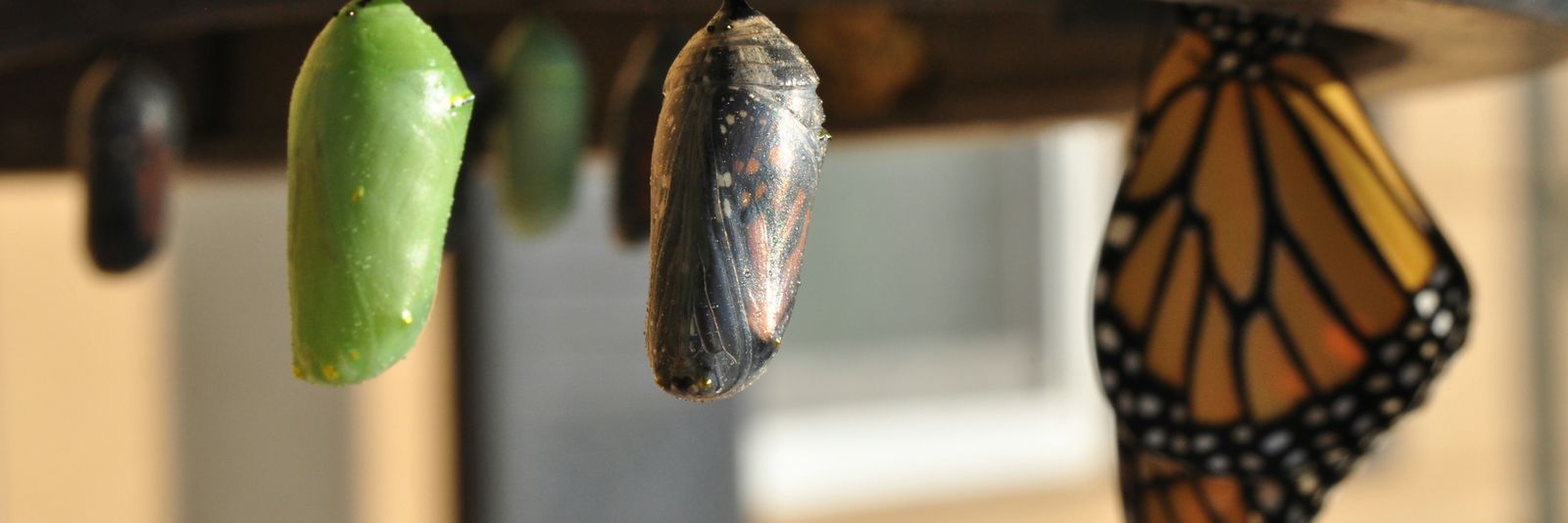
Reproduction is how a species continues. Every organism has a life cycle, the sequence from being born or hatched, through growth, to reproducing in turn.
Two kinds of reproduction
| Kind | How it works | Offspring | Examples |
|---|---|---|---|
| Sexual | two parents each contribute genetic material | differ from both parents and from each other | most animals |
| Asexual | one parent produces offspring alone | genetically identical to the parent | hydra budding, many bacteria, some sea stars |
The trade is straightforward. Asexual reproduction is fast and needs no mate. Sexual reproduction produces variation, and variation is what lets a population survive a change in its environment, because some individuals may happen to cope where others cannot.
Metamorphosis
Many animals change form dramatically as they develop.
| Type | Stages | Examples |
|---|---|---|
| Complete metamorphosis | egg, larva, pupa, adult, with the young looking nothing like the adult | butterfly, beetle, fly, bee |
| Incomplete metamorphosis | egg, nymph, adult, with the nymph resembling a small adult | grasshopper, cricket, dragonfly |
A frog goes through its own version: egg, tadpole with gills and a tail, then an adult with lungs and legs. In every case the larval stage usually eats different food from the adult, so the young do not compete with their parents.
Inherited and acquired traits
| Trait | Kind | Passed on? |
|---|---|---|
| Eye colour | inherited | yes |
| Natural fur pattern | inherited | yes |
| A scar from an injury | acquired | no |
| A skill learned by practice | acquired, learned | no, though it can be taught |
| Size reduced by poor nutrition | acquired | no |
Offspring inherit traits from their parents, not the results of their parents' experiences. A dog whose tail was injured does not have puppies with injured tails.
Parental care and numbers
There is a pattern worth noticing across species. Animals that produce enormous numbers of offspring usually give them little or no care, and most do not survive. Animals that produce few offspring usually invest heavily in each one. A fish may release thousands of eggs and abandon them. An elephant has one calf and protects it for years. Both strategies work, and which one a species uses shapes almost everything else about its life.
Common mistakes
Thinking learned skills are inherited
They are not. They can be taught to the next generation, which looks similar and is not the same thing.
Calling every young insect a larva
A larva belongs to complete metamorphosis. A nymph, which looks like a small adult, belongs to incomplete metamorphosis.
Check yourself
Why does sexual reproduction produce variation?
Because each offspring receives a combination of genetic material from two parents, so no two are identical.
A grasshopper hatches looking like a small adult. Which kind of metamorphosis is that?
Incomplete. The stages are egg, nymph, adult, with no pupa.
Is a scar an inherited or an acquired trait?
Acquired. It happened during the animal's life and is not passed to offspring.
Why do animals that produce thousands of eggs usually give no parental care?
Because the strategy relies on numbers rather than protection. Enough survive by chance alone, which would not be true for a species that has only one or two offspring.
See also
Sources
- Reproduction, metamorphosis and inherited versus acquired traits as taught in United States upper elementary life science. Examples on this page are our own.